Optical Reflectometers – How Do They Compare?
Optical reflectometers measure light reflected from a fiber, component, or photonic device to identify loss, defects, and other events along the optical path. Reflectometry launches a probe signal, measures the returned light, and calculates the relationship between the transmitted and reflected signals.
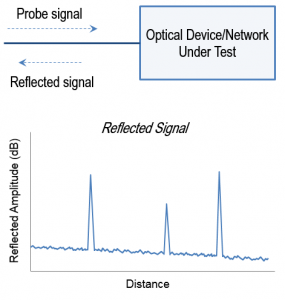 Spatially resolved reflectometers can map return loss along the optical path, identifying and locating problems. There are three established technologies available for spatially-resolved reflectometry:
• Optical Time-Domain Reflectometry (OTDR)
• Optical Low-Coherence Reflectometry (OLCR)
• Optical Frequency-Domain Reflectometry (OFDR)
Optical Time-Domain Reflectometry (OTDR)
The OTDR is currently the most widely used type of reflectometer for optical fiber. OTDRs launch optical pulses into the optical fiber and measure the travel time and strength of the reflected and backscattered light.
These measurements create a trace, or profile, of the returned signal versus length. OTDRs are particularly useful for testing long fiber optic networks, with ranges reaching hundreds of kilometers. The spatial resolution (the smallest distance over which it can resolve two distinct reflection events) is typically in the range of 1 or 2 meters. All OTDRs, even specialized ‘high-resolution’ versions, suffer from dead zones – the distance after a reflection in which the OTDR cannot detect or measure a second reflection event. These dead zones are most prevalent at the OTDR connector and at any other strong reflectors.
Optical Low-Coherence Reflectometry (OLCR)
OLCR is an interferometer-based measurement that uses a wideband low-coherence light source and a tunable optical delay line to characterize optical reflections in a component. While OLCR can achieve high spatial resolution down to tens of micrometers, the overall measurement range is limited, often to only tens of centimeters. Therefore, the usefulness of the OLCR is limited to inspecting individual components, such as fiber optic connectors.
Optical Frequency-Domain Reflectometry (OFDR)
Finally, OFDR is an interferometer-based measurement that utilizes a wavelength-swept laser source. Interference fringes generated as the laser sweeps are detected and processed using the Fourier transform, yielding a map of reflections as a function of length. OFDR is well suited for applications that require a combination of high speed, sensitivity, and resolution over short and intermediate lengths.
Luna OFDR Platforms: OBR and LWA
Luna’s Optical Backscatter Reflectometers (OBRs) are a special implementation of OFDR, adding polarization diversity and optical optimization to achieve unmatched spatial resolution. An OBR can quickly scan a 30-meter fiber with 10-micrometer sampling resolution or a 2-kilometer network with 1-millimeter resolution.
For modern component and network testing, Luna’s OFDR-based portfolio also includes the LWA 7600 Series, the newest platform in Luna’s OFDR-based test portfolio. The LWA 7600 Series provides high-resolution reflection and transmission measurements for optical components, modules, and networks.
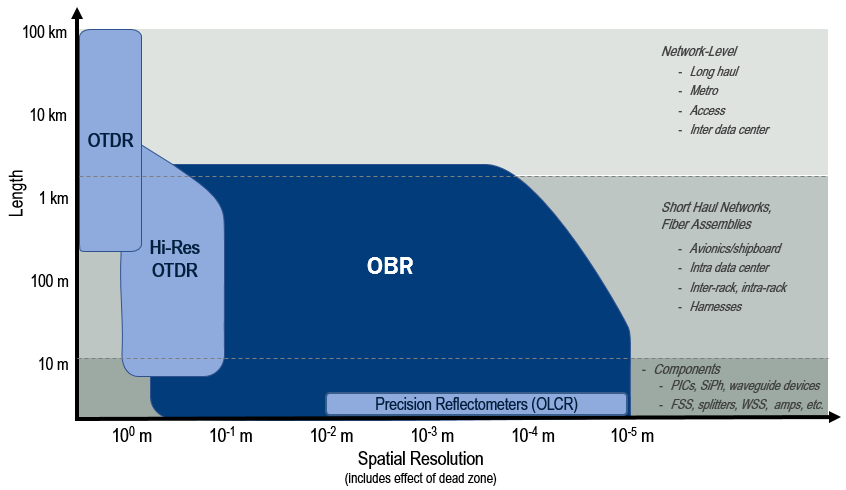
This graphic summarizes the landscape of established optical reflectometry technologies. By mapping the measurement range and spatial resolution of the most common technologies, the plot illustrates OBR's unique application coverage.
Learn More. Download the OBR - Overview and Applications White Paper