Precision or Speed? One OFDR Platform That Ends the Trade-Off in Optical Component Test
Introducing the LWA 7600 Series Lightwave Analyzer: Full OFDR characterization for the optical components and networks powering AI, in C, C+L, and O bands.
Optical component test has always forced a choice: precision or speed, depth or throughput, R&D or production. The instruments built for one end of that spectrum were rarely good at the other. Most test programs ended up split across tools with a lab setup that saw everything but couldn’t keep pace, and a production setup that was fast but saw only part of the picture.
As AI data-center build-out ramps, test teams are squeezed on four fronts at once: volume, cycle time, parameter depth, and precision. The bands in play now span C, C+L, and O, and increasingly a single test organization is testing photonic integrated circuits, coherent transceivers, optical circuit switches, specialty connectors, and fiber-array units on the same test floor. The tools built for the lab were never built for that shift.
No single legacy instrument captures all of it. A reflectometer locates an event but says nothing about its spectrum, and a spectrum analyzer does the reverse, so teams run several tools and correlate the results by hand. OFDR is the one technology that captures both in a single scan, but not every OFDR platform is built the same. Most still force a trade-off among speed and parameter depth, so engineers keep choosing what to give up.
One platform that does both
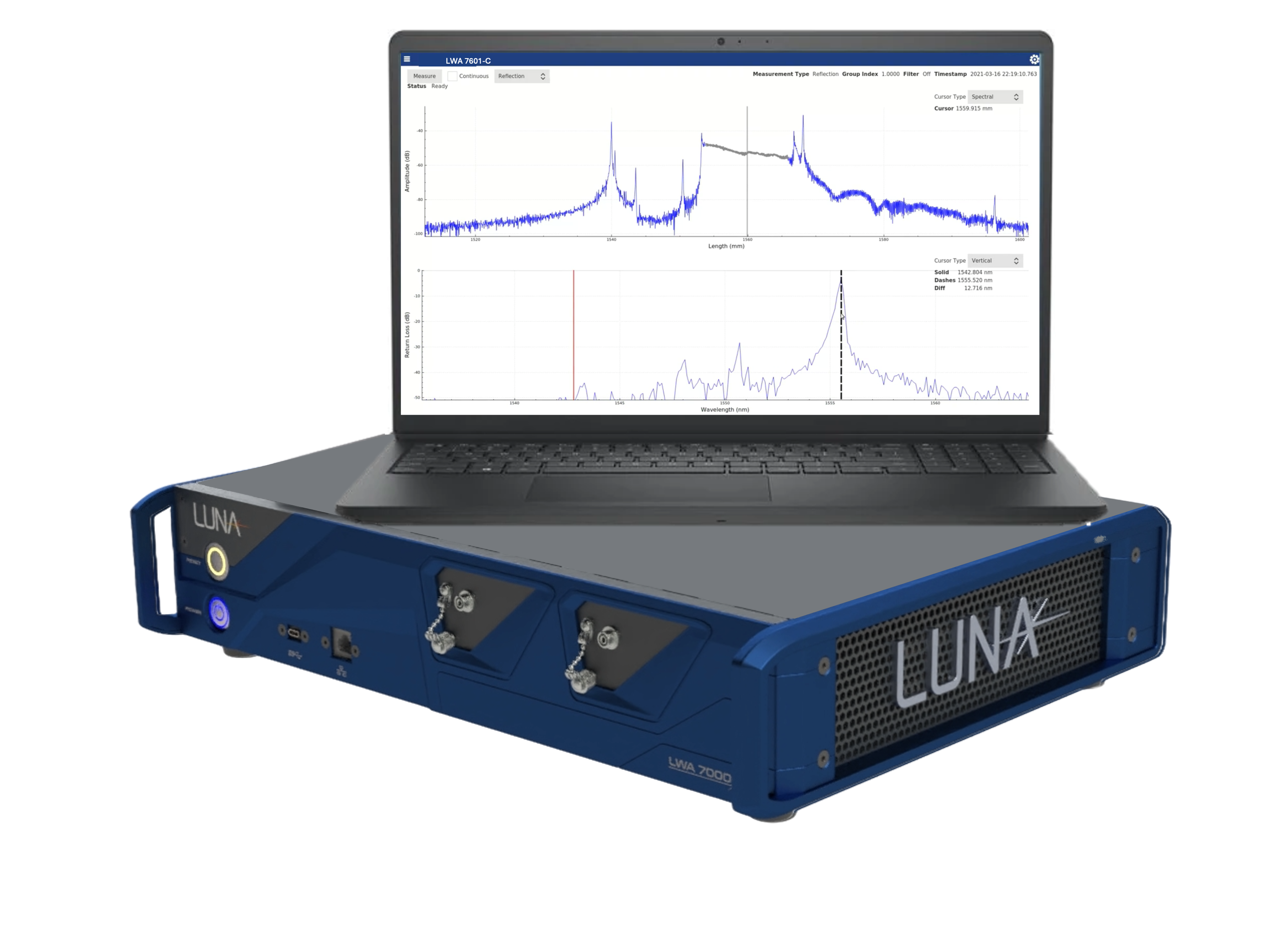
The LWA 7600 Series is a family of Lightwave Analyzers built on Luna’s Optical Frequency Domain Reflectometry (OFDR) platform. It’s designed to erase the trade-off so the same tool that characterizes a device on the bench can qualify it on the line using the same measurement and the same software.
Two capabilities make that possible, and one differentiator makes both practical.
Locate every optical event. The LWA 7600 Series pinpoints optical events at 10 µm resolution inside a fiber assembly or a cable subassembly, and 4.3 µm inside a PIC. Zero dead zone at the connector face means it sees events right at the fiber interface, where many failures actually start. Sensitivity to −145 dB and 90 dB of dynamic range bring out the faintest reflections in the most crowded assemblies. Root-cause work that once took hours of teardown collapses into a single scan.
Capture the full optical picture in one scan. A single scan, on one connection, measures insertion loss, return loss, and length, with spectral analysis of every event, in both reflection and transmission. It shows where an event sits and its spectral response at once, so one scan does what used to take a reflectometer, a spectrum analyzer, and a lot of manual correlation.
Fast enough for production, precise enough for R&D. The platform is the fastest OFDR on the market, with a sub-second scan on C band (12 Hz) and about one scan per second on C+L and O (1 Hz). That speed is what lets one platform serve both R&D and 24/7 production. SCPI over TCP/IP drops it straight into ATE and probe-station lines. Measurement time stops being the bottleneck, and precision stays where it belongs.
One thing datasheets rarely say: a sampling-resolution number isn’t the resolution you actually get. Chromatic dispersion, vibration, and motion during a scan all blur closely spaced events, and a faster scan limits that blur. That makes the LWA 7600 Series’ speed a resolution story, not just a throughput one.
Underpinning all of it: across the family, the LWA 7600 Series covers C, C+L, and O bands with a consistent UI and software stack, and measurement range up to 1,000 m, further than any other OFDR reaches. You choose the instrument for your band and get the same workflow on every one, so you’re not learning or juggling different tools.
Built for where optical test is growing
The same family reaches the applications pulling optical test forward: silicon photonics and PIC characterization; transceiver, co-packaged optics, and optical-circuit-switch production; fiber-array unit and specialty-connector test; and the latency-critical fiber certification HFT and quantum applications demand. Different devices, different bands, different volumes, all handled with a consistent measurement approach from first characterization to final production qualification.
For years, optical component test meant choosing from precision or speed, depth or throughput, R&D or production. The LWA 7600 Series is built so you don’t have to choose. It sees the full picture, keeps pace, and follows your parts from first characterization to full production.
Want to see how the LWA 7600 Series compares to your current optical test setup? Contact Luna to talk through your application, or see the full specifications and datasheets on the LWA 7600 Series product page.