Fiber Optic Latency and Length Testing
Luna's OBR systems can measure fiber optic latency with picosecond accuracy.
Fiber optic latency is the transmission delay caused by light traveling through an optical fiber. Measuring and verifying the latency or length of a fiber optic network or link is important for some critical network applications and fiber optic systems.

In optical networks where action on a message is time-critical, such as high-speed trading, latency becomes a critical design element. Latency in communications networks comprises message networking and processing, as well as transmission delay through the physical fiber. Measuring and optimizing this optical transmission delay can be critical in diagnosing latency issues in a data center or maintaining quality control in the production of precision fiber links.
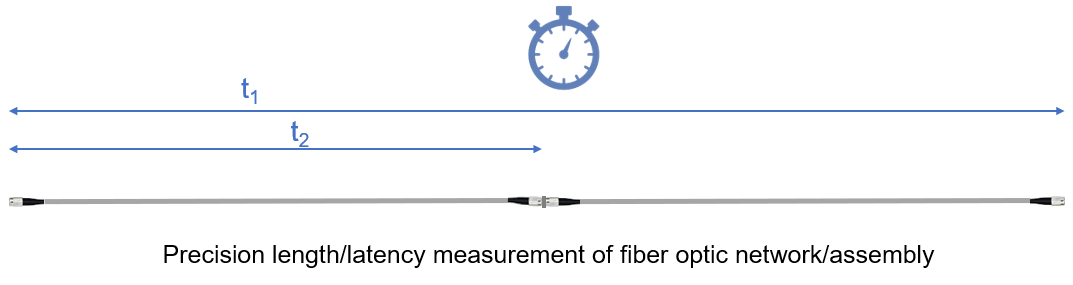
Similarly, some fiber optic systems, such as interferometers and radar systems, depend on very exact fiber length and latency for proper operation.
Fortunately, Luna’s OBR systems can measure fiber optic latency with picosecond accuracy. For example, the OBR 4600 can measure network latency with a sampling resolution of 10 micrometers and an absolute accuracy of <0.0034%. For a 100 m network, this translates to a measurement accuracy of 3.4 mm (about 16 picoseconds). The portable and rugged OBR 6225 provides similar accuracy of 4 mm for a 100 m network.
Featured Products
